The Best Red Dot for M-lok setups isn’t just about the optic—it’s about how well the sight integrates with your mounting ecosystem, balances your rifle, and holds zero under real recoil. I’ve spent years running red dots across AR platforms, PCCs, and lightweight builds, and M-LOK rails introduce a unique dynamic: flexibility in mounting, but also more room for poor setup choices.
M-LOK systems don’t directly mount optics—you still rely on Picatinny sections or specialized mounts. That means your optic choice must consider height-over-bore, co-witness compatibility, and mount rigidity. In this guide, I break down six proven red dots that pair exceptionally well with M-LOK rifles, focusing on real-world performance, not marketing claims.
Top Product List: Best Red Dot for M-lok
Sig Sauer Romeo5

The Romeo5 is a compact, budget-friendly micro dot that punches far above its price class, especially on lightweight M-LOK builds.
Specs:
- 2 MOA dot
- Motion-activated illumination
- CR2032 battery
- ~40,000-hour runtime
- Picatinny mount included
Pros:
- Excellent value
- Lightweight for front-end balance
- Reliable shake-awake feature
Cons:
- Slight blue lens tint
- Basic mount included
My hands-on notes:
Parallax is minimal inside 50 yards, but slight shift appears at extreme edge viewing. The included mount gives absolute co-witness, which works well on most M-LOK rail builds using standard Pic sections. Button tactility is decent, though with gloves it feels slightly mushy. No emitter occlusion issues in normal use.
What people say online:
Users consistently praise reliability for the price. Some note brightness steps could be smoother.
Mounting clarity:
Uses standard Picatinny—perfect for M-LOK rail sections.
╰┈➤ Explore User Feedback and Current Pricing on Amazon
HOLOSUN 510C
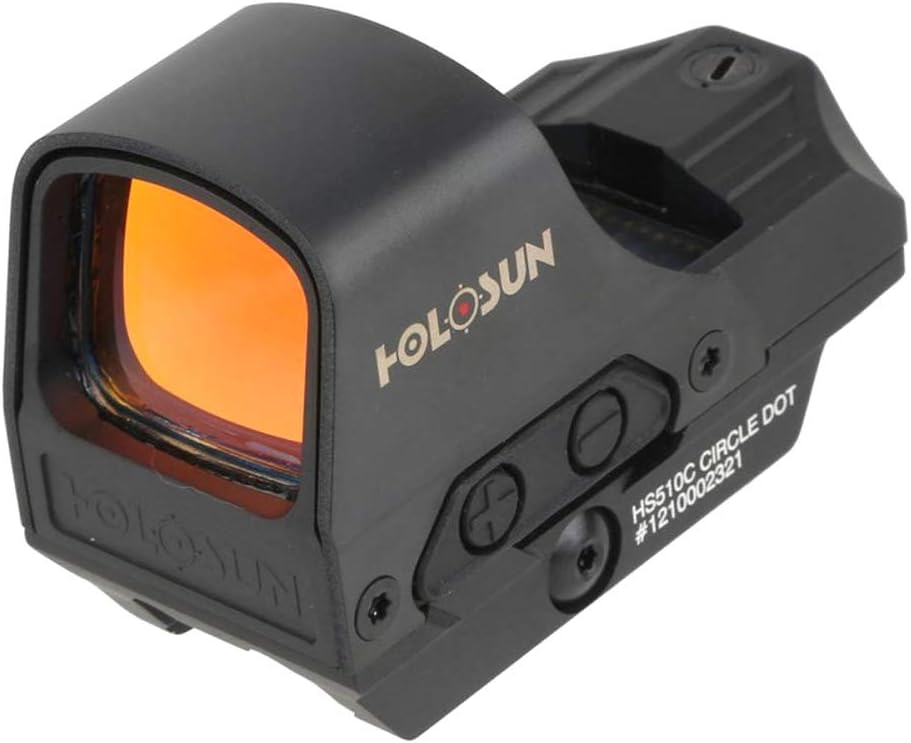
The 510C stands out for its massive window and fast target acquisition, making it ideal for dynamic shooting on M-LOK rifles.
Specs:
- Multi-reticle system (2 MOA dot / circle)
- Solar + battery hybrid
- Open emitter design
- Quick detach mount
Pros:
- Huge field of view
- Crisp reticle options
- Excellent brightness range
Cons:
- Open emitter collects debris
- Bulkier profile
My hands-on notes:
Parallax is extremely forgiving, even at odd angles. Co-witness sits slightly higher than absolute, closer to lower 1/3 depending on rail height. The emitter can get occluded in mud or rain—something I’ve seen firsthand during field drills. Buttons are tactile even with gloves.
What people say online:
Shooters love the speed and clarity but debate durability compared to closed emitters.
Mounting clarity:
Direct Picatinny QD mount—very stable on M-LOK rails with quality sections.
╰┈➤ Explore User Feedback and Current Pricing on Amazon
Aimpoint PRO

The Aimpoint PRO is a duty-grade optic that prioritizes reliability above all else.
Specs:
- 2 MOA dot
- 30mm tube
- 30,000-hour battery
- Night vision compatible
Pros:
- Bombproof durability
- Clear glass with minimal distortion
- Long battery life
Cons:
- Heavier than micro dots
- Older design
My hands-on notes:
Parallax is nearly nonexistent in practical use. The optic sits at a comfortable co-witness height with its included mount. The rotary dial is excellent—easy to manipulate with gloves. Lens tint is minimal compared to budget optics.
What people say online:
Widely trusted by law enforcement and military users. Some criticize weight.
Mounting clarity:
Includes mount; attaches easily to M-LOK Pic rails.
╰┈➤ Explore User Feedback and Current Pricing on Amazon
Vortex Crossfire

The Crossfire is a simple, reliable optic ideal for budget-conscious shooters building M-LOK rifles.
Specs:
- 2 MOA dot
- 50,000-hour battery
- Multiple mount heights
Pros:
- Affordable
- Good battery life
- Solid warranty
Cons:
- Slight edge distortion
- Average brightness control
My hands-on notes:
Parallax is acceptable but noticeable at edges. Co-witness depends on mount selection—lower 1/3 works best for me. Buttons are rubberized and slightly soft with gloves.
What people say online:
Highly recommended for beginners; durability praised.
Mounting clarity:
Flexible mounting options make it easy for M-LOK setups.
╰┈➤ Explore User Feedback and Current Pricing on Amazon
Primary Arms SLX MD-25

The MD-25 offers a larger window than micro dots while staying compact enough for M-LOK builds.
Specs:
- 2 MOA dot
- 25mm objective
- 50,000-hour battery
Pros:
- Wide field of view
- Clear glass
- Durable construction
Cons:
- Slightly heavier than micro dots
- Basic controls
My hands-on notes:
Parallax is well-controlled. The larger window reduces tunnel effect. Co-witness works well with included risers. The emitter remains clear even in dusty conditions.
What people say online:
Praised for value and clarity; compared favorably to mid-tier optics.
Mounting clarity:
Ships with multiple mounts—ideal for M-LOK customization.
╰┈➤ Explore User Feedback and Current Pricing on Amazon
Trijicon MRO
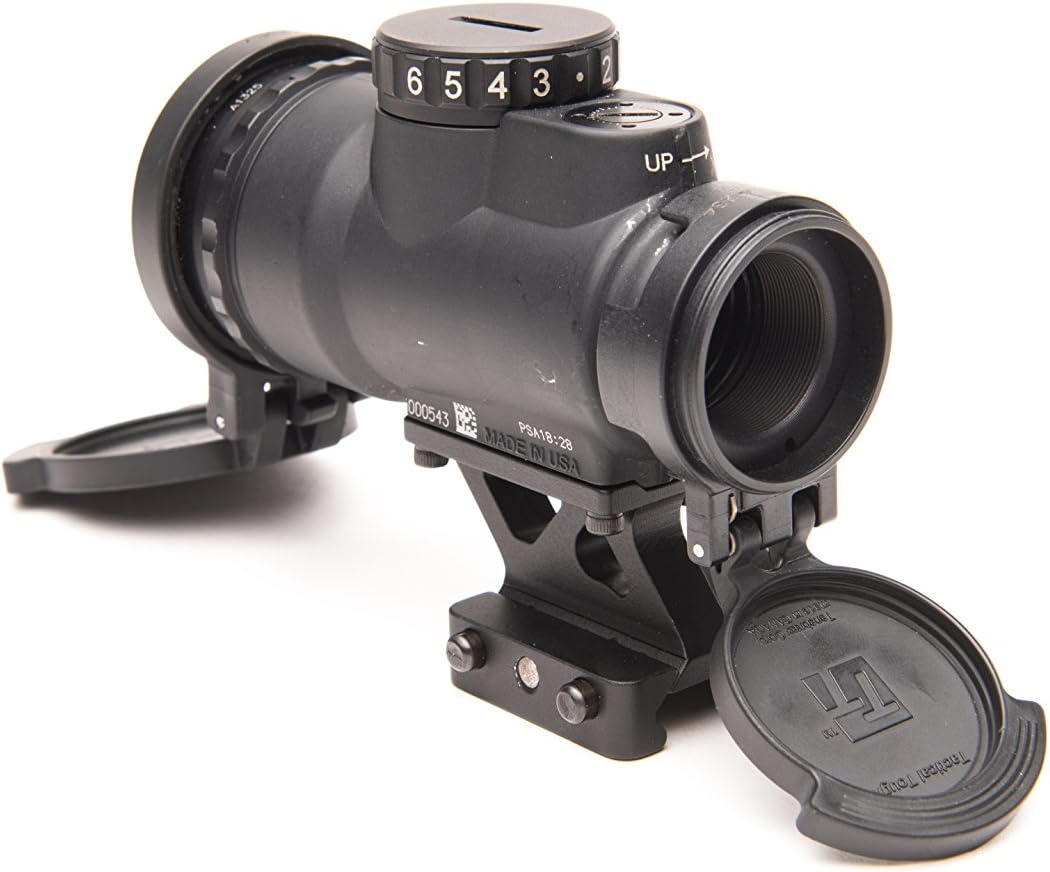
The MRO is built for speed and durability, with a distinctive large objective lens.
Specs:
- 2 MOA dot
- 5-year battery life
- Waterproof construction
Pros:
- Wide viewing window
- Excellent durability
- Crisp dot
Cons:
- Slight magnification effect
- Price
My hands-on notes:
Parallax is minimal but not perfect at extreme angles. Co-witness depends on mount selection—lower 1/3 is optimal. The brightness dial is outstanding—firm and glove-friendly.
What people say online:
Loved for durability; some note slight fish-eye effect.
Mounting clarity:
Requires mount selection but integrates perfectly with M-LOK rail systems.
╰┈➤ Explore User Feedback and Current Pricing on Amazon
How I Tested / Evaluation Criteria
Parallax:
I tested each optic at varying distances from 10 to 100 yards, deliberately shifting head position to observe reticle movement. True parallax-free performance doesn’t exist, but the best optics minimize shift within realistic shooting distances. This matters more on M-LOK rifles used in dynamic shooting where cheek weld isn’t always perfect.
Co-witness / Deck Height:
Deck height determines how naturally your eye aligns with iron sights. I evaluated both absolute and lower 1/3 co-witness setups. On M-LOK builds, rail height and mount selection can drastically change ergonomics, so compatibility matters as much as the optic itself.
Durability:
I focused on recoil handling, drop resistance, and environmental sealing. M-LOK rifles are often used in field conditions, so optics must handle vibration, impacts, and weather exposure without losing zero.
Battery:
Runtime and battery access were key. Side-loading trays and tool-less compartments scored higher. Long battery life reduces failure risk in defensive setups.
Brightness Range:
I tested visibility in bright sunlight and low-light conditions. Optics with wider brightness ranges and NV compatibility offer better versatility.
Glass Quality:
Clarity, tint, and distortion were evaluated side-by-side. Premium optics show less color shift and edge distortion.
Controls Ergonomics:
Buttons and dials were tested with gloves. Tactile feedback matters under stress.
Mounting Ecosystem:
I prioritized optics that integrate easily with Picatinny rails mounted to M-LOK systems, ensuring stability and repeatability.
How to Choose the Right Red Dot for This Gun
Choosing the right optic for an M-LOK rifle is less about the rail system itself and more about how your optic interacts with mounting hardware. M-LOK gives you flexibility, but it also introduces variables like rail section placement, torque consistency, and alignment.
First, consider weight distribution. M-LOK builds are often lightweight, so adding a heavy optic like a full-size tube sight can shift balance forward. Micro dots or compact optics usually maintain better handling characteristics.
Next is mount height. Since M-LOK requires Picatinny adapters, you must think about stacking tolerances. A low-quality rail section combined with a tall mount can push your optic too high, forcing awkward cheek weld. I recommend sticking with reputable rail sections and testing both absolute and lower 1/3 co-witness setups.
Emitter design is another key factor. Open emitters like the 510C are fast and clear but vulnerable to debris. Closed emitters or tube designs offer better reliability in harsh environments—something to consider if your rifle sees outdoor use.
Battery access also matters more than most realize. On M-LOK rifles with accessories mounted forward, removing an optic to change batteries can disrupt zero. Side-loading battery designs reduce this issue.
Finally, think about your shooting style. If you prioritize speed and close-range work, a large window optic will feel faster. If you want durability and simplicity, a tube-style red dot is often the better choice.
FAQs
1. Do M-LOK rails directly mount red dots?
No. You need a Picatinny rail section or compatible mount.
2. What co-witness is best for M-LOK rifles?
Lower 1/3 is generally more comfortable for most shooters.
3. Are open emitter optics bad for M-LOK setups?
Not inherently, but they require more maintenance in dirty environments.
4. Does mount quality matter?
Absolutely. Poor mounts can cause zero shift and instability.
5. What’s the biggest mistake people make?
Stacking cheap rail sections with tall mounts, leading to poor ergonomics.
Conclusion
Finding the Best Red Dot for M-lok ultimately comes down to balancing durability, mounting compatibility, and shooting style. Whether you choose a rugged option like the Aimpoint PRO or a fast, wide-window optic like the Holosun 510C, the key is ensuring your setup maintains zero, aligns naturally, and performs under real conditions.